
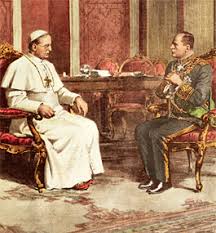
The photograph above is of Pope Pius XI and Benito Mussolini at a meeting in 1932.
Kevin Frederick, the president of the American Waldensian Society, recently had free time to read a number of old American Waldensian Society newsletters. This is the third of three articles in which Kevin summarizes what these newsletters reveal about impact of Fascism and war on Italian Waldensians.
William Attwood reported in an American Waldensian Society newsletter in 1948:
The Lateran Pacts signed between Pope Pius XI and Benito Mussolini on February 11, 1929, established a strong alliance between the Fascist government of Italy and the Roman Catholic Church in Italy. The essence of these pacts, consisting of the Treaty of Conciliation, the Financial Convention, and the Concordat, declares that the Catholic religion is the only religion of the State thereby effectively subsuming the rights of Italy’s Protestant minority which, at the time, totaled less than five percent of the Italian population.
Three days after signing the pact, Pope Pius XI wrote of Mussolini:
There was need for a leader like the one Providence sent us.
Mussolini described himself as an atheist and yet ironically was identified as a savior by the Pope. Although the Lateran Pacts put an end to the division between the Catholic Church and the Italian State, its terms specified that the sovereignty of the Pope would be limited to the 121 acres known as the State of the Vatican City. This allowed Mussolini and his Fascist party to assert control of the hearts and minds of the Italian people and still enjoy the blessing of the Pope.
Dr. Virgilio Sommani, Moderator of the Italian Waldensian Tavola in 1947, wrote:
In the Concordat there are articles even more injurious to freedom of conscience and religion. Article 1 of the Concordat says, ‘in consideration of the sacred character of the Eternal City, episcopal See of his Holiness the Pope, center of the Catholic World and goal of pilgrimages, the Italian Government will take care to prevent in Rome whatever may be in contrast with the character specified above.’
In other words, the Fascists agreed to defend the Italian Catholic Church against all criticism. In so doing they earned the loyalty and submission of the Roman Catholic Church.
Freedom of conscience is one of the essential tenets of Reformed Christianity. The freedom to think and offer criticism of society and its political leaders has long been a cherished value of Protestants. As a result, Protestants often remained a vocal and often undaunted voice of criticism of the Fascist government. Many lost their freedom and their lives as they defended this right.
By 1941, it was increasingly clear that the Fascists were using the pope and the Roman Catholic Church to justify their oppressive control. A news release of that year from the American Waldensian Society quoted the Italian Fascist publication Il Regima Fascista:
The Holy See has urged the Italian government to persevere with unheard-of persecutions against the Protestants. We Fascists do not wish to protest against these crusades and persecutions that are made without mercy. Instead, we would rather justify them because the Church is not able to defend itself merely reciting the Rosary and respecting liberty of conscience, to quote the reigning Pope.
In the Province of L’Aquila, for example, the Methodists have constructed a church building. For several years now, they have sought in vain for permission to go there for prayer. Because the Italian government does not wish to displease the Vatican, it has not yet decided to say that there is no objection.
The Papacy proved to be a loyal and faithful ally of the Fascist government, and the Fascists manipulated Catholicism while remaining independent of it.
Historians have noted that Mussolini had elevated himself to a demigod.
Salvatore Gatto, deputy secretary of the National Fascist Party wrote:
Fascism is a civil and political religion because it has its own concept of the state and its own understanding of life.’ Mussolini himself wrote, ‘In order for fascism to succeed, it needed to become not a science or a philosophy, but a faith.’
As the 1930s progressed, all but a fraction of Italians viewed Mussolini as their national savior. Fascism in Italy prioritized loyalty to Il Duce over independent thinking and competence. As the war progressed, Italians were commanded to suspend independent thinking and debate, and to follow the Fascist government obediently and subserviently. This led to the destruction of the nation and the widespread rejection of Mussolini at the end of the war.
The acquiescence of the Roman Catholic Church in the 1920’s and 1930’s along with its desperate desire to maintain power over a changing society allowed the Fascists to rise to authoritarian power over a great European nation. This was accompanied by a suspension of critical thinking and blind subservience to Il Duce.
Mussolini and his Fascist party led Italy and Europe into the deep darkness of war, destruction, chaos, and death. Silence and blind submission allowed this evil to occur unchecked until tremendous damage was all that was left. Today we must guard against the warning signs of authoritarian leadership in our own day and time in every nation on this fragile planet we call home.
