
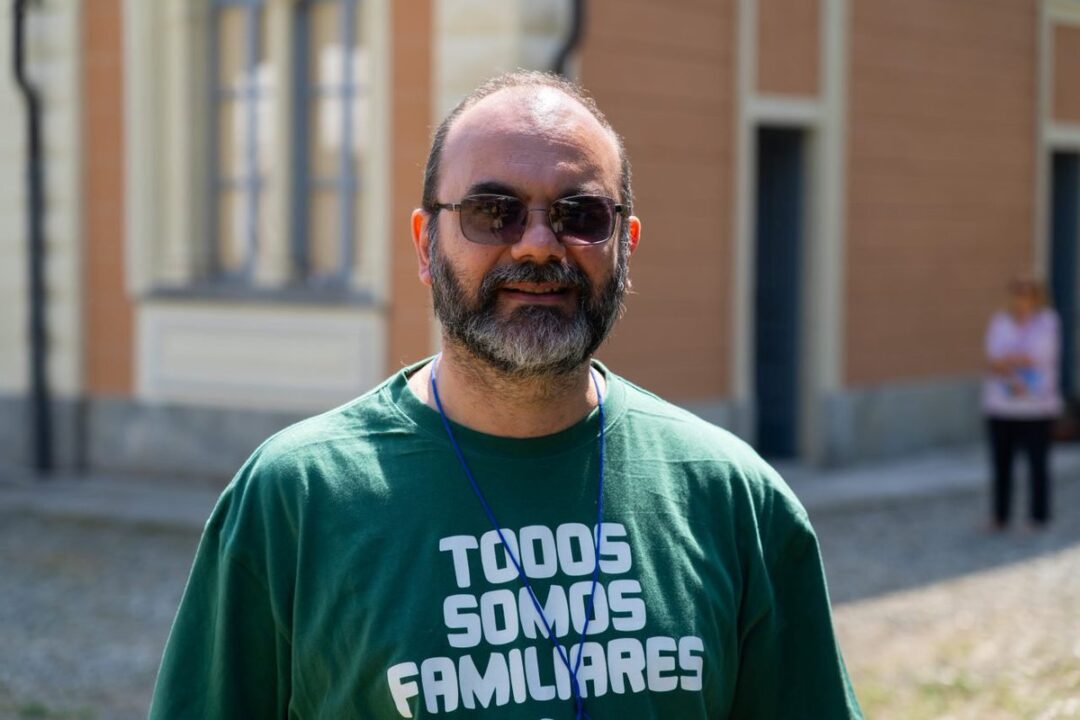
A few weeks before the next synod meeting of the Evangelical Waldensian Church of the Rio de la Plata, the South American Waldensian publication “Tenemos Esperanza” interviewed the church´s moderator, Pastor Marcelo Nicolau. Marcelo, who is pictured above wearing a t-shirt imprinted with Spanish words that translate, “We are all family,” spoke about the work of the past year and the challenges through which the Evangelical Waldensian Church of the Rio de la Plata is going.
Question: What were the priorities of the Waldensian governing board – or Mesa – for its work during this last year?
Moderator Marcelo Nicolau: In 2025, the Mesa continued working on the five basic priorities that have been its focus during the last couple years. Those five priorities are:
– Support for youth work
– Progress in the redesign of our diaconal work
– Developing a balanced and sustainable budget
– Equipping our congregations for more effective mission
– Strengthening ecumenical theological education
What challenges in our social and political context do you think are important for the church to address as it responds to God´s call to engage in mission?
Marcelo: Without a doubt, our social context presents some significant challenges. I can point out three that seem especially important for us to engage for us to be effective and coherent witnesses to Jesus Christ.
– The devaluation of the collective and the solidary. In an individualistic and selfish society, it is essential to witness to Jesus´ teachings about love of neighbor and the importance of our life together.
– The devaluation of decency and kindness. In a society in which violence – in all its forms – is finding defenders and promoters, it is more important than ever that we become agents of reconciliation and peace, just as Jesus was.
– The normalization of injustice. Accepting injustice among human beings and toward creation as something normal cannot be our answer, simply because it was not what Jesus did. In our world today, the tendency of many is to look the other way, just as the priest and the Levite did in Jesus´ parable of the Good Samaritan (Luke 10:25-37). Our challenge today is simply to have compassion in a world with little compassion.
What will be the theme of this upcoming synod and why did you choose it?
Marcello: The motto for our synod will be “walking in hope, joy and peace” and is based on Romans 15:13. The Mesa wanted to convey the idea that church must be in motion and that motion has a foundation which is our hope in Christ and that hope is linked to joy and peace, two sorely needed values for our time.
We live in an era of discontent with institutions and an overweening emphasis on the individual. This is generating violence, hatred, and a growing disinterest in societal problems. It is challenging, not to say difficult, to be a community of faith in our current context.
Marcello: It is precisely in a difficult context such as ours that it is most important to focus on our community life. This requires that we become builders of a society in peace. On the Friday evening during our synod meeting, we will have a discussion focused on the theme “Conversing to live together: Working toward a culture of peace.”
Moreover, as we plan for this discussion, we know that in order to talk, we must be willing to listen, because otherwise there is no dialogue. Today we live in a society in which shouting, outbursts, and insults predominate, none of which require listening at all. Indeed, in our society listening is often seen as a weakness. But we follow the One who taught us to listen.
Jesus did not create a movement of isolated, self-absorbed individuals concerned only with their own well-being. That kind of community is the creation of the society in which we live. On the other hand, living, vibrant communities will always be a creative alternative to this isolation, simply through the space they make for authentic encounter. That is why it is necessary to be silent, to listen and to let the Spirit of God speak to us and challenge us. That is why music gives us expressive possibilities that sometimes the simple word cannot. As Martin Luther said, by singing we pray twice. In a way, the synod is a never-ending experiment in finding the necessary balance between the logical and rational on the one hand, which is, of course, necessary, and the spiritual power of faith and hope, which makes life richer, more abundant, and tastier.
The upcoming synod meeting will take place January 29 – February 1 in the Parque 17 de Febrero in the Playa Fomento in the Department of Colonia, Uruguay. Dennis Smith, an AWS board member and a retired Presbyterian Church (USA) missionary, will represent the American Waldensian Society at the meeting.
This interview appeared first in Tenemos Esperanza, a publication of the Presbytery of Colonia Sur of the Evangelical Waldensian Church of the Rio de la Plata.
