
The end of World War II on May 8, 1945, revealed a continent devastated by the ravages of six years of war. Globally more than 60 million people had died. In Europe, tens of millions had been left homeless, destitute, and starving. Food, clothing, and medical supplies were virtually non-existent across vast areas of Europe. The European economy was wrecked. And the war in the Pacific still raged for another four months with no certainty of peace until mid-August.
After the most basic survival issues had been addressed, and after military tribunals had brought war criminals to justice, millions began to rebuild their lives and their communities. Many world leaders tried to make sense of the devastating wreckage and loss of life by vowing to rebuild their nations on the principles of democracy. They called for cooperation between nations that had been mortal enemies with each other.
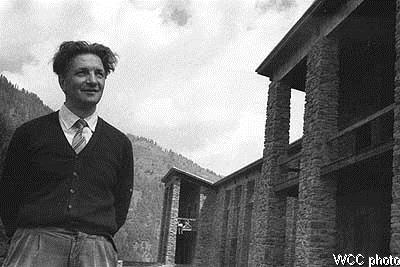
One of the brightest examples of a hope-filled vision came from the Waldensians, and specifically from a young pastor named Tullio Vinay. Tullio Vinay had come from a family of Waldensian pastors. He graduated from the Waldensian Seminary in Rome. He helped save dozens of Jews by hiding them in a secret apartment in the church he was serving during the worst years of Fascism. He also served as the Waldensians’ general secretary for youth work during the war. In an American Waldensian Society newsletter dated May 1951, entitled “Spiritual Stockpiling for Peace at Agape,” Vinay was described as “a leader who inspires rather than directs. His faith is so convincing that none can doubt him for long.”
The same newsletter describes the seminal idea behind the founding of Agape Center as follows:
The wartime sufferings of all, the enduring force of Christian love, which carried him through hardships, danger and great sacrifice for others, brought Rev. Tullio Vinay, the courageous Youth Leader of the Waldensian Church to understand what an English Soldier meant when he said to him one day among the ruins of Florence, “We are no longer English, or French, or Italian, or German, but all Christians.” It was as if the fires of war had removed the masks of nationalism and bared the hearts of men. Tullio conceived the idea of “Agape the Love of Christ”- a cross in the center of war-torn Europe. Let us make it possible for the youth of the world to unite in work and devotion to that love and so find the power which can bind them to all human beings as brothers and sisters.”
So Agape, a center for sacrificial work, worship, recreation, and study for young people of every nation, class and creed, was started.
Pastor Vinay elicited the assistance of the great Italian architect Leonardo Ricci, who caught the vision of Agape and commented, “If Agape is to be a monument of God’s love, it must be a true and beautiful monument.”
Starting in 1946, Tulio Vinay, along with seven other young leaders, visited numerous Waldensian Churches to raise funds to build the new Agape Center. News traveled across the Atlantic to Valdese, North Carolina, and the Waldensian industrialist Albert Garrou. Albert Garrou had been brought by his parents from Italy to Valdese along with his younger brother. Albert donated land he and his family owned in Prali in the Germanasca Valley to be the building site for the new Agape Center. In 1947, with insufficient funding but a clear vision fueled by faith, Tulio Vinay and a small group of volunteers mined tons of limestone and felled dozens of trees. They burned the limestone to make lime for the concrete that was used in the footers, which were all hand dug. No heavy-duty construction equipment was ever used in the building of Agape. The construction work, accompanied by sporadic fund-raising, was spread over four difficult and challenging years. Slowly the number of youth and young adult volunteers grew into the hundreds. They came from several European countries and from the USA to volunteer for several months at a time.
The Agape Center was dedicated on August 12, 1951, with representatives from multiple denominations. In the approximately 75 years since then the organization has hosted thousands of young people at hundreds of conferences and Tulio Vinay’s original vision has resulted in the creation of countless life-long friendships and a spirit of trust and understanding between people from all around the world.
When offered a choice of responding to the horrors of war with retribution and revenge or selfishness and graft, young Waldensians instead embraced a vision guided by faith in a God of love and justice. Under Tulio Vinay’s leadership, they created a place for worship and building community, a retreat center which nurtured peace and understanding, a sanctuary of hope which offered a vision of human harmony and divine justice.
Agape stands as a witness to a better future in a world which, even in the decade after the war, was still influenced by religious oppression and control. After the end of World War II, the Christian Democratic Party of Italy, made up mainly of Roman Catholics, still governed the nation with the understanding that Roman Catholicism was the only true Italian religion. It was only with Vatican II, in 1965, that Protestants were officially acknowledged as valued partners in the Body of Christ. Through it all, the Waldensians continued to be guided in their faith and actions by the love and justice of Jesus Christ.
In 2015, after hundreds of years of suppression and sometimes even persecution by the Roman Catholic Church, the Waldensians were able to make a new beginning with the Roman Church. Pope Francis officially met in worship with Waldensian leaders in a Waldensian Sanctuary in Turin. There the Pope offered a profound apology to Waldensians for the countless persecutions against the Waldensian people committed over hundreds of years. Tullio Vinay’s vision of creating Agape, a retreat center where love is central and where all are accepted, listened to, and seen as children of a loving God had finally come full circle. That vision still provides a calling of hope, direction, and purpose in our time with the challenges we face around the world. That same ancient Christian witness is urgently needed today.
The author, the Rev. Dr. Kevin Frederick, is the president of the American Waldensian Society and the now retired former pastor of the Waldensian Presbyterian Church in Valdese, North Carolina. Kevin is the author of With Their Backs Against the Mountains: 850 Years of Waldensian Witness.
The New Testament word “agape” refers to unconditional, selfless, even sacrificial love such as the love that Jesus embodied. It is distinguished from “eros” and “philia” by the fact that it does not ask for anything in return.
Many of the young volunteers who helped Tullio Vinay build the Agape Center came from Italy. Many others came from Germany. Others came from France, the United Kingdom, the United States, and many other countries that had been in a life and death struggle with Germany. The fact that, so soon after the end of World War II, young people from all these nations could work beside each other offered its own vision of God’s reconciling Agape.
Frank Gibson, a long-time executive director of the American Waldensian Society was a volunteer at the Agape Center in the 1950s. Peter Sulyok, a former president of the American Waldensian Society, was also a volunteer at the Agape Center in the 1980s.
