
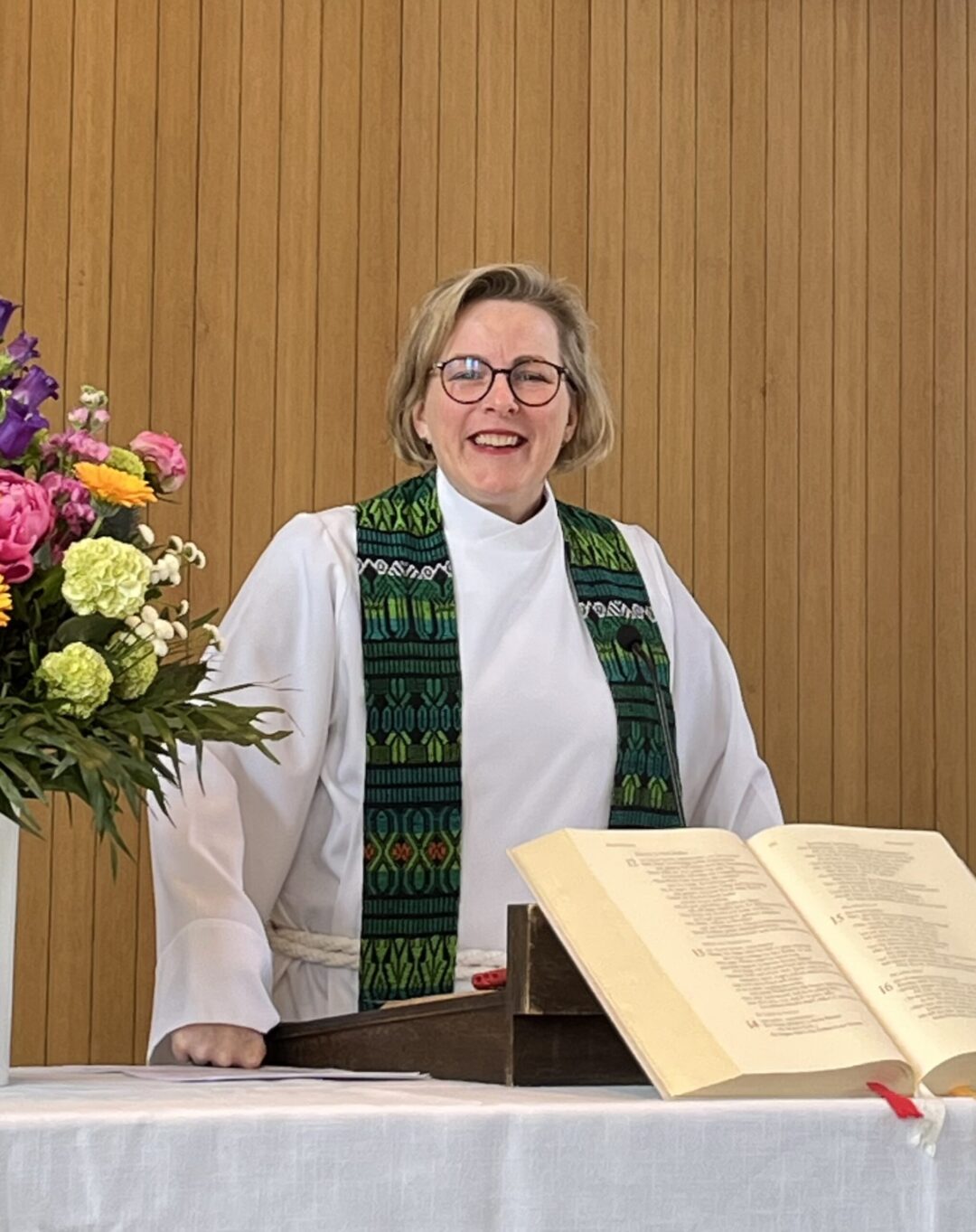
The following is an Advent sermon preached by Rev. Dr. Gretchen Schoon Tanis, a member of the senior pastoral team at Hope Church (RCA) in Holland Michigan. Gretchen and her husband, Phil, (who helped to create the new AWS website, waldensian.org) recently moved back to Holland, Michigan from Hannover, Germany. Her message is one we all need to hear as we wrestle with what it means to live as people of hope seeking to serve the Prince of Peace. Hope has a sharp prophetic edge when it is understood—as it is in this sermon—as being far more “in your face” than its meeker sister, optimism.
I confess I felt a little smug with perhaps a hint of superiority. Please hear me – I don’t mean that as a good thing. It just popped up and I did my best to tamp it down as I shared my expertise. This was the situation: living abroad, our kids went to an international school and that granted us the gift of interactions and friendships with people from around the world. One of the joys was the opportunity to explore Europe for those of us from outside the European continent. After one Easter holiday, friends from Mexico returned from their trip to the Netherlands over break with bags of tulip bulbs in hand, excited to get those planted and see them bloom in the weeks to come. And that’s where the smugness crept in. I had to break it to them gently, as the knowledgeable veteran Dutch American, when to plant tulip bulbs in the autumn in order to see them bloom in the spring. Our friends were disappointed they wouldn’t see their bulbs bloom that year, of course, but were grateful to know what to do and when to expect results.
Isaiah chapter two had me remembering fondly our international community. I tend to lean towards embracing the pomp and circumstance of international events like the Olympics or the World Cup. Isaiah 2 evokes visions of nations streaming towards the mountain of the Lord and begins with these words, “The word that Isaiah saw concerning Judah and Jerusalem.” This word saw, in Hebrew, literally means vision – Isaiah saw in a vision the intentions of God. Quite often, at the beginning of the season of Advent, churches around the world read this vision from Isaiah to remind ourselves what the final vision of God is for humanity. I often think that, while these scripture passages sound strange to our ear or curious to our concept of the coming Jesus tender and fragile, wrapped in blankets and surrounded by animals and outsiders, we need this final vision of God to spur us into this season of hope. To be reminded of the final victory of God. We have this vision of Isaiah that fills us with hope and inspiration. God will settle disputes. God will arbitrate between people groups. Swords will be beaten into plowshares and spears into pruning hooks.
Have you ever seen a blacksmith at work? I haven’t really seen one fully at work other than on TV and at a few living history villages like Plymouth in Massachusetts and Fort Mackinaw here in Michigan. To be a blacksmith is hot, dirty, hard work. But this is the vision of God – that instruments of war will be turned into instruments of gardening. It doesn’t happen flippantly or easily. It’s hard work to transform vengeance into vegetables, anger into acorns, hatred into the harvest. Through Isaiah we capture once again the vision of God for humanity, that we are to grow and bear fruit – to plant hope – sowing seeds of peace that raise a harvest of righteousness. I came across this quote about hope that inspired me a few years ago. It was posted on social media from a friend of mine from my college and says, “People speak of hope as if it is this delicate, ephemeral thing made of whispers and spider’s webs. It’s not. Hope has dirt on her face, blood on her knuckles, the grit of cobblestones in her hair, and just spat out a tooth as she rises for another go” (Matthew@crowsfault from Becky Schmidt on Facebook). This vision, this hope that God has for humanity is not a tender, fragile thing, but one that requires our hard work, our determination to give it our all in order to fulfill the vision and reality that through Jesus Christ God’s kingdom has drawn near. I was thinking about the timing of planting tulip bulbs and how you need to plant them at the right time in order to see them bloom when the time is right. This is the very call for us this day – to plant seeds of hope for the world so that the blossoms of God’s purposes will bear fruit in the seasons to come.
Our Advent theme for Hope Church this year is “Hope Among Us,” and with this understanding we are called to envision in the manner of Isaiah the hope of God in the person of Jesus that is already amongst us. Brené Brown teaches us that, “Hope is a function of struggle – we develop hope not during the easy or comfortable times, but through adversity and discomfort. Hope is forged when our goals, pathways, and agency are tested and when change is actually possible” (Atlas of the Heart, p. 101). We hear the call of Jesus to keep awake, to be at the ready, to call out and articulate, where we see the glimpses of the kingdom of God drawn near. “The community of faith around the world has been hoping for a very long time. The substance of that hope, deeply rooted in the Old Testament, is persistent and resilient. As both the prophetic oracle and the psalm attest, [the people of God] hope for justice, peace, and well-being. The biblical community knows God’s intention for these matters and trusts God’s faithful promise. Thus, Advent begins in a vision of a healed alternative for the world” (Texts for Preaching, Year A, p. 1).
During Bible study this week, one of our participants shared a poem that connected to this vision of our weapons of horror being turned into gardening tools of hope. It’s written by Wendell Berry, our farmer theologian, and is titled “The Seeds.”
The seeds begin abstract as their species,
remote as the name on the sack
they are carried home in: Fayette Seed Company
Corner of Vine and Rose. But the sower
going forth to sow sets foot
into time to come, the seeds falling
on his own place. He has prepared a way
for his life to come to him, if it will.
Like a tree, he has given roots
to the earth, and stands free.