
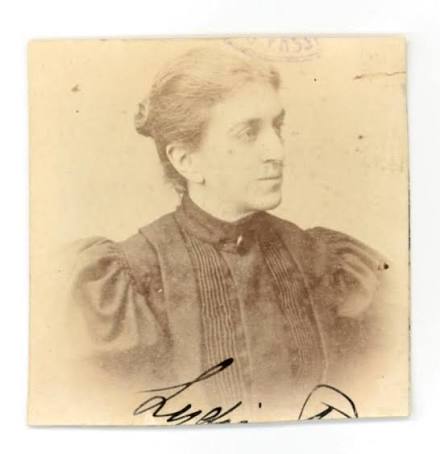
The first Italian woman with a degree in law was of course…a Waldensian born in Traverse, a hamlet above Perrero (Val Germanasca) in 1855. Lidia Poët came from a rich family locally known as the “Lords of the Valley.” There were six brothers and three sisters. When her brother Jean Henri opened his legal office in Pinerolo, the family moved there, also because the father had died. As a little girl Lidia was already stubborn and rebellious, very quick in defending her opinions and fascinated by books, reading everything she could put her hands on. At 13 she decided to study Latin, which wasn’t usual for girls at the time. She obeyed the family who told her to study in order to become a primary teacher and then was sent to learn German and English in Switzerland, hoping she would forget her obsession with Latin. It didn’t happen, though, and privately she studied for the diploma required for enrolling in Law.
This she did in 1878 at Turin University: the only woman, the first in Italy. At the beginning it wasn’t easy. All the young men were staring at her, often sending written messages. But she persisted undaunted — ignoring them and achieving great results in the exams. When she was supposed to study forensic medicine at the Faculty of Medicine, she asked the Vice-Chancellor if she could be spared attending in person, fed up as she was with the interest that she had attracted at the Faculty of Law that was only beginning to relent after two years. The Vice-Chancellor happened to be the famous criminologist Cesare Lombroso, who scolded her with a piercing gaze: “When one starts, they have to go all the way, Signorina. I certainly won’t exempt you from attending the lessons!” Lidia acquiesced and, in 1881, she graduated triumphantly with a brilliant thesis on the status of women. It advocated for their right to vote and was dedicated to her mother and her brother Jean Henri, who had been her strongest supporters. Her graduation was witnessed by more than 500 applauding students and was reported in the newspapers, which published her portrait, adding that she wasn’t a stiff spinster with a pince-nez but a young woman who got a degree in Law without giving up her feminine charm and glamour.
She then enrolled as a trainee solicitor in a firm in Pinerolo and worked for two years. Meanwhile she passed the exam needed to become an attorney in 1883 with excellent grades. All she needed now was enrolment in the roll of Barristers and Solicitors. After a very animated discussion and a vote of 8 people in favor against 4, she was accepted on 1 August 1883. Despite women being already accepted as medics and scientists, practicing law seemed different, and several people responsible for the admission were contrary. Hence, they appealed against it and after Lidia contested their decision, battles, and fights followed until, in June 1884, the whole story ended up in Rome in front of the Parliament of the Kingdom of Italy. MPs in favor noted that Poët came from those Alpine Valleys where her ancestors had fought bitter battles for the freedom of religion. Debates for and against followed until everything was postponed indefinitely in a typical Italian way…
Eventually she got enrolled in 1920, at 65! Meanwhile Lidia kept working for her brother and was active in Italy and Europe (the French Government nominated her Officier d’Académie), fighting for women’s rights but also for minors and prisoners. During World War I she was a Red Cross nurse for soldiers, earning a silver medal.
Wherever she went she made special friends: in Paris alone these included Victor Hugo, Maupassant, Verlaine …
She was active until the end, dying at age 95.
Italian TV made a Netflix series very loosely based on the true story. Not having seen it, I can’t judge it.
The author of this report, Erica Scroppo Newbury, pictured below, has been the executive secretary of the English Committee in Aid of the Waldensian Missions since 1988.
