
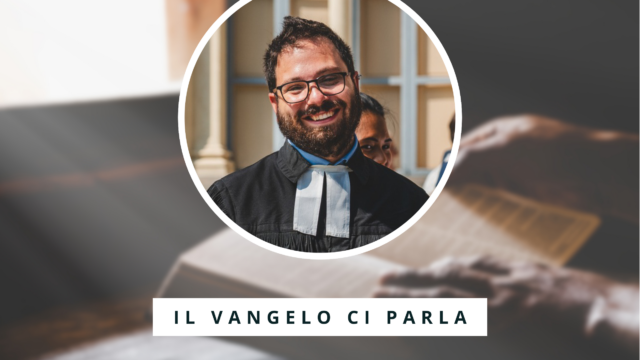
The newsletter of the Waldenser Freundeskreis recently published an interview that many members and friends of the American Waldensian Society will find interesting. Giovanni Bernardini, pictured above, who is currently the pastor of the Waldensian Church in Riesi, Italy, was the interviewee.
The interviewer was Till Hüttenberger, a member of the pastoral team in the Evangelical Peace Church in Mönchengladbach in North Rhine-Westphalia, Germany. Till is pictured below.
Till’s questions are in bold text. Giovanni’s replies are in plain text.
Giovanni, you are a young pastor in the Waldensian Church. In Germany, we always hear about the great shortage of new pastors in Italy, just as we have in Germany. How do you assess the current situation of pastoral ministry in the Waldensian Church?
I have hope for the future. People sometimes say that we have a lack of candidates for ministry in our churches in Italy. But that is not true. In many churches – especially in small congregations – there are people who offer themselves for service of the local church. They are also responding to a call to ministry. However, it is true that we do have a crisis with people deciding to pursue pastoral ministry as a full-time profession. The point is that saying we have a lack of vocations overlooks the many people who live out their calling by serving their church at the local level.
Do volunteers take on many pastoral tasks in the congregations?
Yes, and there are many people who serve with great passion. Often, these people are highly competent. Nowadays, however, it is difficult for people to decide to go to the theological faculty. Why is that? Mostly for financial reasons. Studying costs money. The courses require mandatory attendance in Rome, which is difficult to manage for people with families. There are scholarships, but they often cannot cover the cost of living. Italy is expensive. This means living for years at a level reduced to the bare essentials.
Are there also part-time or specialized educational opportunities for people who feel called to ministry as volunteers?
Such opportunities exist, and people gladly make use of them. But it always depends on one’s current job, of course, regarding how well a course of study and one’s work life can be balanced.
Giovanni, you spent your first years of ministry in Riesi, Sicily – in a congregation with a long tradition, but also in a unique situation, given how few and far apart Protestant congregations are in Sicily. This summer, you will move to the north and begin a new ministry in congregations near Venice. What experiences will you take with you from Riesi? What have you learned during your time in Riesi?
Above all, I have learned that as a pastor, you must be ready to start from scratch again and again. You cannot just arrive and impose your own ideal image of ministry. You must always engage with people’s actual life stories, concerns, and realities on the ground. You have to be a good listener and understand that people have their own way of life. You have to immerse yourself in the specific local context. The local context is different in Sicily than it is in the north of Italy. I also learned that even in situations in which you feel alone or lonely, you must not be afraid to ask colleagues for help. In other words: you must not be afraid of the telephone. It is not just a tool for work. It is a medium that connects. An exchange of ideas, even over long distances, can help enormously.
I will leave Riesi enriched. Because I had to reinvent myself as a pastor, I learned to express myself differently, to preach differently, to plan ministry differently, and to experience time differently. And when I enter a new and different reality, I won’t just know a single model for pastoral ministry. I will be able to compare familiar ways of operating but hope I will also be able to find better ways and thereby do my ministry better.
What awaits you in Venice? Is it true that you will be serving four congregations?
Yes. Venice-Mestre—meaning the mainland, as they say there. Venice-Mestre also includes Treviso and Conegliano. A huge challenge awaits me there: two Reformed churches and two Methodist churches. Treviso and Conegliano are predominantly made up of people with African backgrounds, mostly Ghanaian. This is a form of Methodism that is often perceived as very orthodox and quite strict in the Italian context. This means entering completely new cultural patterns. I will have to rely heavily on volunteer leaders of the congregation. I won’t simply be the pastor who comes in and does everything. Instead, I will need to learn how to interact with these families and congregations.
Are the individual congregations each different in character?
Yes, completely different—in their history as well as in their social and cultural makeup. Furthermore, I will be working with a new church council. Currently, it consists of one member from each congregation. All four congregations are represented. This is beautiful because it means we will work together. In addition, a dynamic ecumenical situation awaits me there. In Riesi, we share some ecumenical activities with the Catholic Church, but in Venice-Mestre there are conferences, debates, cultural events, and much more.
By ecumenical, do you also mean contacts and relationships with other religions?
In Venice-Mestre, ecumenism means contact not only with the Catholic Church, but also with Muslims and, above all, with other Christian churches. Naturally, the strongest relationships are with the historic churches, such as the Lutheran Church.
One last question: What is the calling of the Gospel in our society today?
God is no longer a priority for many people in our society. In the past, God was omnipresent throughout a society shaped by Christianity and Catholicism. In the past, theological work was carried out with great passion at all levels of the Waldensian Church. People studied, educated themselves, and debated theological questions. Today, I believe, the Gospel is proclaimed through one’s own life. Your whole life becomes a living testimony of what you believe.
That means words and actions go together.
Exactly. People don’t listen to you because you show up and say, “Hello, let me tell you about Jesus Christ.” But if you bear witness through your behavior, your ethical choices, and your way of living, then people will eventually come to you on their own and ask, “Can you explain better what you believe?” This really happens – not frequently, of course, because we live in a secularized society, but it happens. We often mistakenly believe that a person’s external appearance is everything. But when people notice that there is genuine substance behind the facade, trust and credibility develop. And if you are credible, then they listen to you. That’s when people ask, “What do you actually believe?” And then you start with the basics: Father, Son, and Holy Spirit, Christ as the sole mediator, salvation by grace, scripture alone… explained in an understandable way, of course. There was a young Christian with whom I often went on long walks in the winter. During these walks, we talked for hours while walking about matters of faith, about the Lord’s Supper, sanctification, and justification. The point is you have to be credible. When people see you as an available and trustworthy person, true evangelism begins. Then people seek these things out themselves. And that is beautiful.
