
Several years ago, few people would have imagined that a thriving children’s library, youth choir, English classes, and Little League baseball teams could emerge from the small border town of Sasabe, Sonora, Mexico.
Like many communities along the U.S.-Mexico border, Sasabe has endured tremendous hardship. During a violent period of cartel conflict in 2023, most residents fled their homes. Buildings were left abandoned, bullet holes scarred walls, beloved pets roamed the streets, and families grieved the loss of loved ones. When the gunshots and violence subsided and the families slowly returned, the community faced a difficult question: How do you rebuild not only buildings, but hope?
The answer began in an unexpected way. Volunteers from the Green Valley/Sahuarita Samaritans first ventured a mere 100 meters across the border, staying close to the safety of the port of entry to feed the abandoned dogs. As they returned week after week with food and water, they would travel further into Sasabe as relationships were renewed with the people who were moving back home. Trust grew. Conversations deepened. Friendships formed.
Rather than arriving with a plan, the Samaritans asked a different question: “What do you dream for your community?” The answers came primarily from the women of Sasabe. Many had endured unimaginable loss. Countless others had lost husbands, partners, or family members during the year of violence. Yet they remained determined to create a different future for their children.
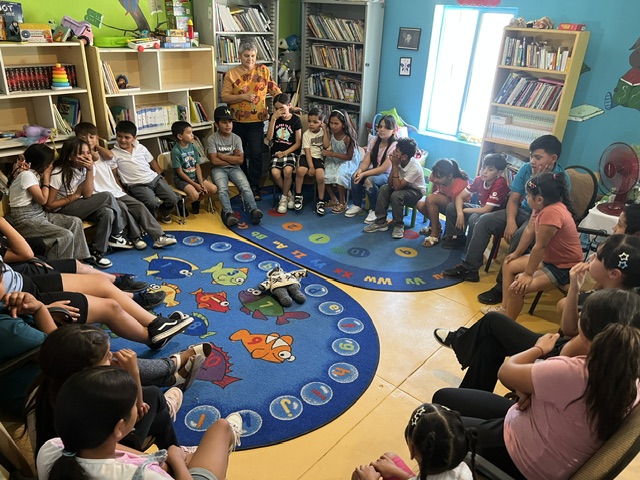
Out of those conversations, the Sasabe Empowerment Project was born. Today, one of its most visible accomplishments is Biblioteca Esperanza–The Hope Library. Literally painted bright, orange with festive flowers, fruit, and butterflies. What was once a bullet-riddled building has been transformed into a center for learning, creativity, and community life. Led by “Las Mamas de Sasabe” and supported by partners on both sides of the border, the library hosts English classes, civic engagement programs, educational activities, and a youth choir. It has become a place where young people can gather safely, learn, and imagine new possibilities for their future. As one nine-year-old participant, Damian, said at the library’s dedication, “Today is my most favorite day of my entire life.”
The project continues to grow. The Samaritans now sponsor two Little League baseball teams. When the players were asked to choose a name for their teams, they proudly selected “Los Sasabe Samaritanos”—a reflection of the friendship and partnership that has developed over the years.
And the dreams continue. The women envision a community garden that will provide fresh food and bring neighbors together. They hope to create a park in the center of town where children can play safely. They dream of opening a restaurant that would provide economic opportunity while celebrating local culture and hospitality. Most importantly, these projects would be owned and led by the women of Sasabe themselves.
For the Green Valley/Sahuarita Samaritans, the Sasabe Empowerment Project has become a reminder that accompaniment is more powerful than charity. Real transformation happens when communities are empowered to identify their own hopes and lead their own development.
The Waldensian tradition has long emphasized faith expressed through service, solidarity, and the dignity of every person. We see those values alive in Sasabe. What began with feeding abandoned dogs has become a movement of neighbors helping neighbors, women rebuilding their community, and children discovering reasons to hope again.
In a place once defined by fear and violence, a new story is being written–one of resilience, empowerment, and possibility.
Sí se puede!
The author of this report, the Rev. Dr. Randy J. Mayer, pictured below, is the lead pastor of the Good Shepherd United Church of Christ in Sahuarita, Arizona. He and his congregation have been involved in humanitarian work along the US/Mexico border for more than 20 years. Randy is a member of the board of directors of the American Waldensian Society.
To learn more about the border ministry, see https://thegoodshepherducc.org/events/common-ground-on-the-border/
